

If you recently had shoulder surgery, you are probably wondering what recovery will feel like.
Common questions patients ask after surgery include:
- How much pain is normal after shoulder surgery?
- How long should I wear the sling?
- When can I start exercises?
- When can I drive or return to work?
- When should I worry and call my surgeon?
This recovery guide explains what to expect during the first days, weeks, and months after shoulder surgery, including pain, rehabilitation, wound care, and recovery milestones.
At Shoulder UAE, we believe that good recovery starts with good education.
Quick Recovery Summary

What Is Shoulder Surgery?
Shoulder surgery includes a range of procedures used to treat common shoulder problems such as:
- Rotator cuff tears
- Shoulder instability and dislocations
- Labral tears (Bankart / SLAP lesions)
- Frozen shoulder
- Shoulder bursitis and impingement
- Biceps tendon problems
- AC joint pathology
Many of these procedures are performed using shoulder arthroscopy, a minimally invasive surgical technique using small incisions, a camera, and specialized instruments.
Although the skin incisions are small, internal healing still takes time.
Recovery depends not only on the surgery itself but also on following the correct rehabilitation plan.
What Is Normal During Recovery After Shoulder Surgery?
During the first days after surgery, it is normal to experience:
- Shoulder pain or soreness
- Swelling around the shoulder
- Bruising in the upper arm or chest
- Difficulty sleeping
- Shoulder stiffness
- Mild discomfort around the neck or shoulder blade
The first 24–72 hours after shoulder surgery are usually the most uncomfortable, especially once the nerve block wears off.
Pain levels vary depending on the procedure performed.
For example:
- A simple debridement usually recovers relatively quickly
- A rotator cuff repair needs more protection and longer healing
- A labral repair often requires sling protection for several weeks
Recovery is not always linear. Some days feel better than others, which is completely normal.
Dr Pablo’s advice:
The first 2–3 days are usually the hardest. Do not panic if pain temporarily increases after the nerve block wears off ; this is expected.
How Much Pain Is Normal After Shoulder Surgery?
Pain after shoulder surgery is expected, but it should gradually improve.
Your prescribed medications may include:
- Paracetamol / Acetaminophen
- Anti-inflammatory medication (NSAIDs), if suitable
- Stronger rescue pain medication if required
- Stomach protection medication
Take pain medication as prescribed, especially during the first few days.
Do not wait until pain becomes severe before taking analgesia.
Ice Therapy After Shoulder Surgery

Ice can help reduce both pain and swelling.
Use ice:
- For 15–20 minutes at a time
- 4–6 times daily during the first week
- Always with a towel between the ice and skin
Cold therapy is particularly helpful during the first 7–10 days.
How Long Should You Wear a Sling After Shoulder Surgery?
The sling protects the surgical repair and supports healing.
Please follow your surgeon’s instructions carefully.
Typical sling duration depends on the surgery:

When Can You Start Exercises After Shoulder Surgery?
One of the biggest concerns after shoulder surgery is stiffness.
Early safe movement helps reduce swelling, maintain circulation, and prevent unnecessary stiffness.
However, rehabilitation must always match the procedure performed.
Exercises From Day 1
Unless your surgeon advises otherwise, begin gentle exercises several times daily:
- Open and close your hand
- Move your wrist up and down
- Bend and straighten your elbow
These simple movements help maintain mobility while protecting the shoulder.
Pendulum (Codman) Exercises

After many shoulder procedures, gentle pendulum exercises may begin early.
To perform pendulum exercises:
- Lean forward slightly using your non-operated arm for support
- Let the operated arm hang completely relaxed
- Make small gentle circles
- Move forward/backward and side to side
Important:
- Keep the shoulder relaxed
- Do not actively lift the arm
- Keep movements gentle and pain-limited
Your physiotherapy program will progress based on your surgery.
Wound Care After Shoulder Surgery
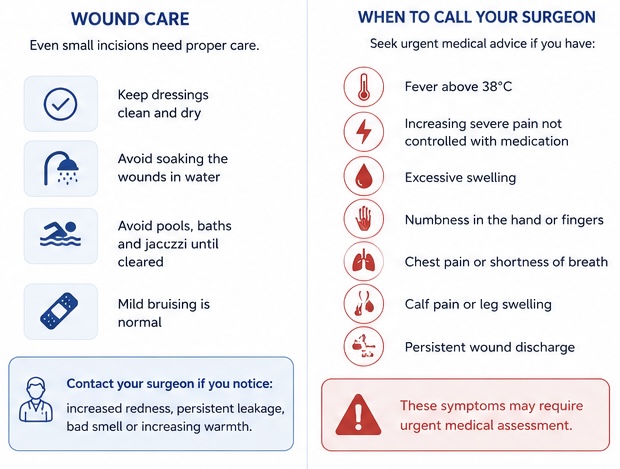
Even though arthroscopy uses small incisions, wound care remains important.
General recommendations:
- Keep dressings clean and dry
- Avoid soaking the wounds in water
- Avoid swimming pools, baths, or jacuzzi until cleared
- Mild bruising around the shoulder or chest is common
Showering is usually allowed after dressing removal or according to your surgeon’s instructions.
Contact your surgeon if you notice:
- Increasing redness
- Persistent wound leakage
- Bad smell
- Increasing warmth around the wound
How to Sleep After Shoulder Surgery
Sleeping is one of the most difficult parts of recovery.
Many patients struggle during the first 1–2 weeks after shoulder surgery.
Helpful tips:
- Sleep semi-upright
- Use multiple pillows for support
- Consider a recliner chair if available
- Keep the sling on during sleep if instructed

Poor sleep during the first weeks is very common and usually improves progressively.
When Should You Call Your Surgeon?
Please seek urgent medical advice if you develop:
- Fever above 38°C
- Increasing severe pain not controlled with medication
- Excessive swelling
- Significant numbness in the hand or fingers
- Chest pain or shortness of breath
- Calf pain or leg swelling
- Persistent wound discharge
These symptoms may require urgent medical assessment.
Shoulder Surgery Recovery Timeline
Recovery time depends heavily on the procedure performed.

Frequently Asked Questions About Recovery After Shoulder Surgery
Why is pain worse on Day 2 or 3 after shoulder surgery?
This is very common and often happens when the nerve block wears off.
Can I sleep without a sling?
Only if your surgeon specifically allows it.
When can I drive after shoulder surgery?
Usually not while wearing a sling or while taking strong pain medication.
When can I return to work after shoulder surgery?
This depends on your job and the procedure performed.
Office-based work may be possible earlier than heavy manual work.
When can I return to sports?
Return to sport depends on healing, strength, and range of motion. Some patients return in 3–4 months, while others need 6 months or longer.
Final Message
Recovery after shoulder surgery takes time, patience, and proper rehabilitation.
Most patients improve steadily with the right balance of protection and guided movement.
Follow your post-operative instructions carefully, attend physiotherapy, and maintain realistic expectations.
If you are unsure about anything during your recovery, do not hesitate to seek medical advice.
Need expert shoulder care in Abu Dhabi?
Book an appointment with Dr. Pablo Menéndez at Shoulder UAE.
This recovery guide is based on evidence-based principles commonly used by shoulder specialists and supported by leading organizations such as the American Shoulder and Elbow Surgeons (ASES), SECEC, and the American Academy of Orthopaedic Surgeons (AAOS).
Further reading from trusted orthopedic organizations: