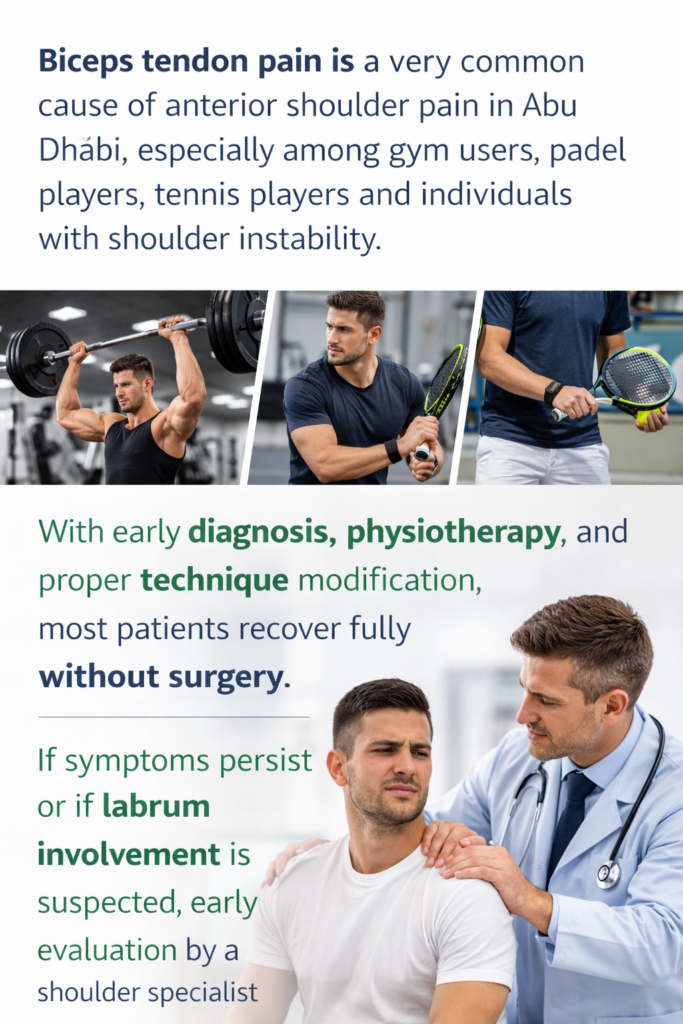
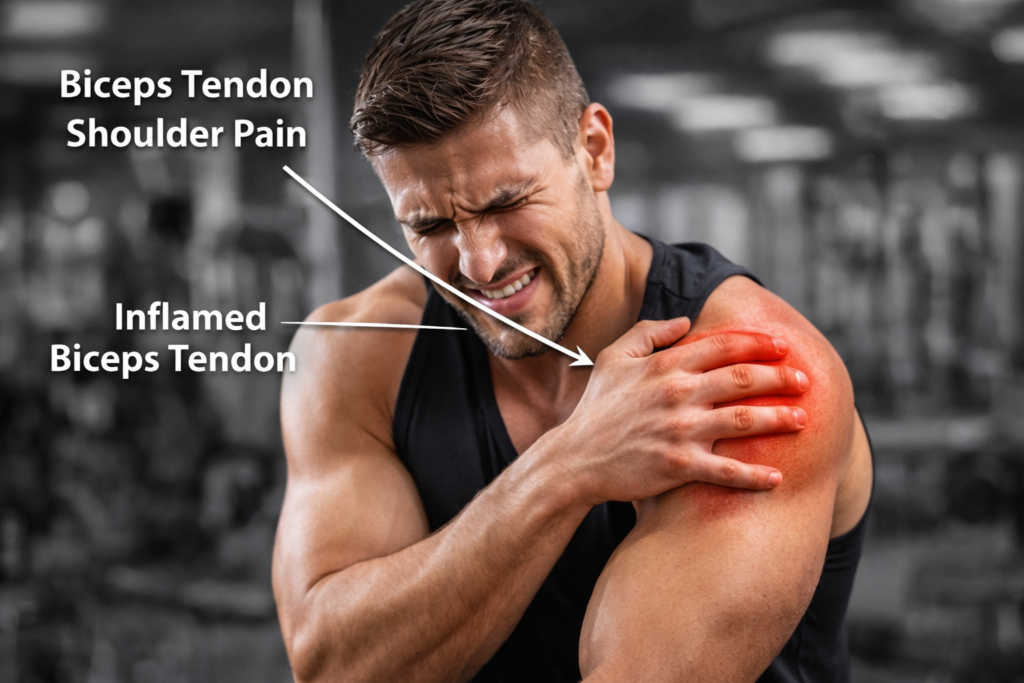
Biceps tendon pain, specifically involving the long head of the biceps, is a common yet frequently misunderstood cause of shoulder pain in Abu Dhabi. Patients often believe their pain comes from the rotator cuff, when in fact the origin is the biceps tendon at the front of the shoulder.
This condition is particularly common among gym users, padel players, tennis players, swimmers, and individuals who perform repetitive overhead activities.
Below is a clear, structured, and patient-friendly guide to understanding biceps tendon pain and the best treatment options available in the UAE.
What Is the Long Head of the Biceps Tendon?
The biceps has two tendons at the shoulder:
- Long head of the biceps (LHB) – runs inside the shoulder joint and attaches at the top of the labrum.
- Short head of the biceps – attaches to the coracoid process and rarely causes problems.
The long head of the biceps is the most common source of anterior shoulder pain.
It can become inflamed, irritated, or degenerated over time, especially with repetitive overhead movements or heavy lifting.
Why Is Biceps Tendon Pain So Common in Abu Dhabi?
Several regional and lifestyle factors contribute to the high incidence:
1. Gym Training and Overhead Lifting

Exercises such as:
- Curls
- Shoulder press
- Bench press
- Pull-ups
- CrossFit movements
place significant stress on the long head of the biceps.
Incorrect technique or excessive weight increases the risk.
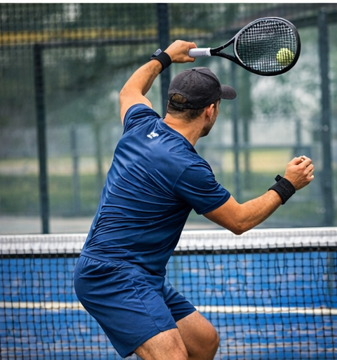
2. Popularity of Padel and Tennis
Both sports involve:
- Repetitive overhead shots
- High acceleration and deceleration forces
This causes micro-trauma to the biceps tendon and its anchor on the labrum.
3. Shoulder Instability and Labrum Tears
The long head of the biceps is closely linked to the labrum.
If there is instability or a SLAP tear, the biceps tendon becomes overloaded and inflamed.
Many patients with “biceps pain” actually have:
- Micro-instability
- SLAP lesion
- Early labrum degeneration
4. Poor Posture and Desk Work
Forward head posture and rounded shoulders increase stress on the anterior shoulder structures, including the biceps tendon.
5. Age-Related Tendon Degeneration
From age 40 onward, the tendon becomes more susceptible to irritation and fraying.
Common Symptoms of Biceps Tendon Pain
Patients in Abu Dhabi typically report:
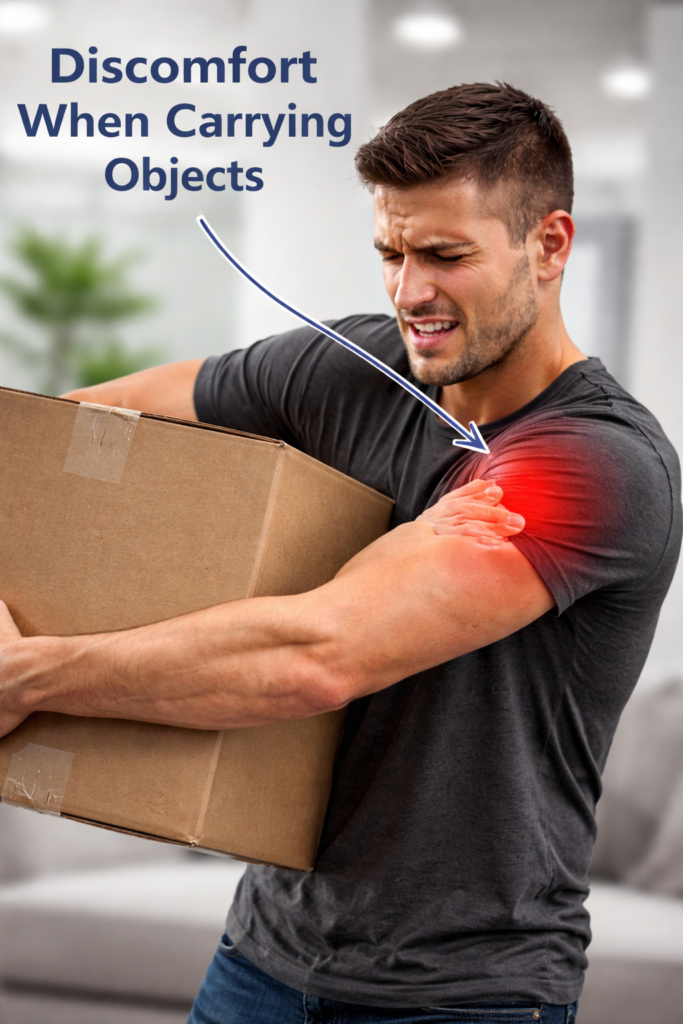
- Pain at the front of the shoulder
- Pain with lifting or reaching overhead
- Discomfort when carrying objects
- Clicking or popping sensations
- Weakness or fatigue during gym exercises
- Pain during curls or overhead press
- Pain radiating down the biceps
Symptoms often worsen during or after exercise.
When Should You See a Shoulder Specialist?
You should seek medical assessment if you experience:
- Persistent pain for more than 2–3 weeks
- Pain that limits sports or gym training
- Clicking or catching sensations in the shoulder
- Pain associated with overhead activity
- Suspected labrum involvement
- A sudden “pop” with immediate relief (possible tendon rupture)
Early diagnosis prevents progression to tendon degeneration or labrum tears.
How Is Biceps Tendon Pain Diagnosed?
1. Clinical Examination

A shoulder specialist evaluates:
- Palpation over the bicipital groove
- Rotator cuff function
- Signs of instability
- Special tests for biceps and SLAP lesions
2. Ultrasound
Useful to evaluate:
- Tendon inflammation
- Tendon thickening
- Fluid in the tendon sheath
- Partial tears
Ultrasound is dynamic and allows assessment during movement.
3. MRI or MRI Arthrogram
Recommended when symptoms persist or when labrum involvement is suspected.
MRI identifies:
- SLAP tears
- Biceps anchor degeneration
- Rotator cuff pathology
- Synovitis
- Tendon fraying or rupture
This is particularly important for athletes and heavy gym users.
Best Treatment Options for Biceps Tendon Pain in Abu Dhabi
Most cases improve with non-surgical treatment.
1. Physiotherapy (Core Treatment)
Physiotherapy focuses on:
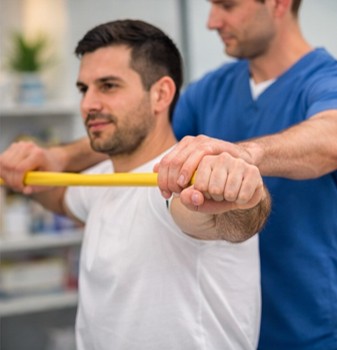
- Reducing inflammation
- Strengthening the rotator cuff and scapular stabilizers
- Improving posture
- Correcting lifting technique
- Stretching the posterior capsule
- Reducing overload on the biceps
This is the most effective long-term solution.
2. Activity Modification
Temporary reduction of:
- Overhead lifting
- Heavy curls
- Chest-focused gym routines
- Repetitive overhead sports
…helps reduce irritation.
3. Anti-Inflammatory Medication
Short-term use can reduce pain during the acute phase.
4. Ultrasound-Guided Injection
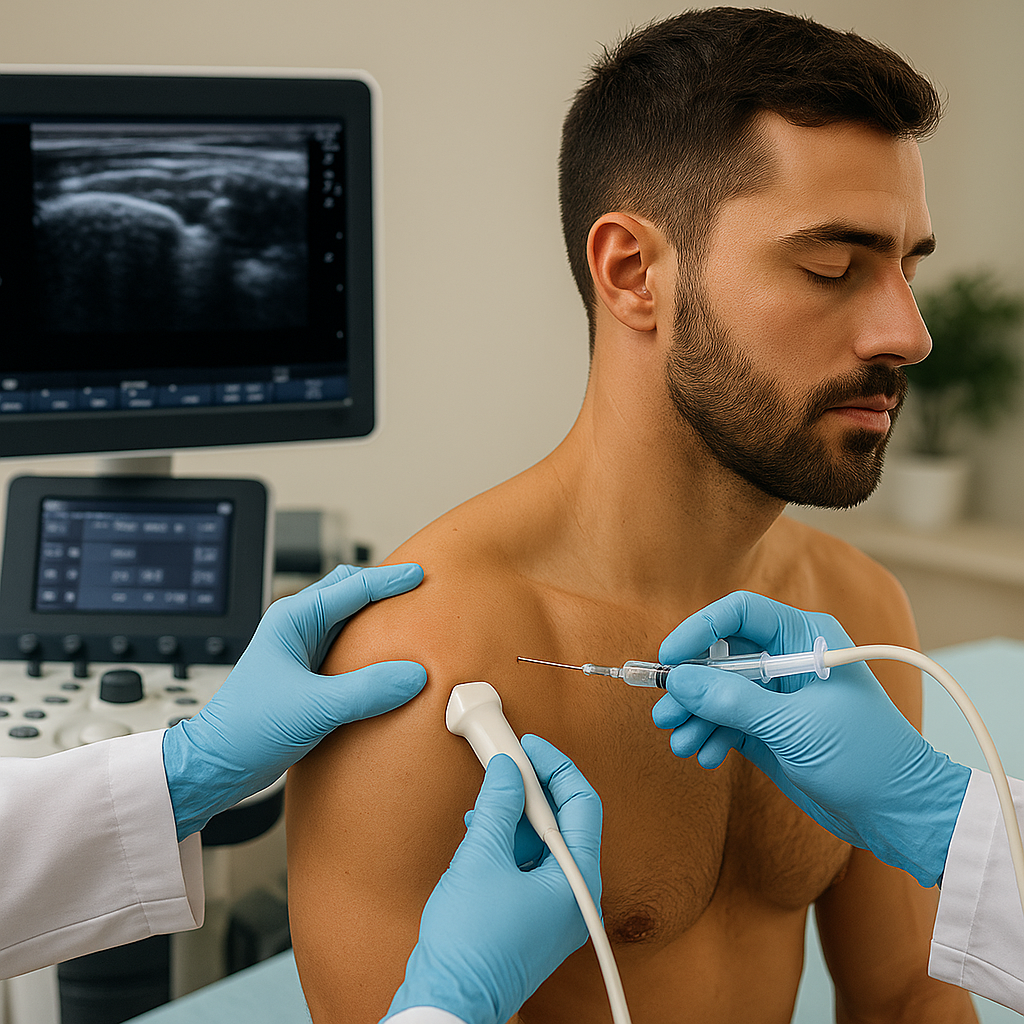
Indicated when:
- Pain is severe
- Physiotherapy progress is limited
- There is significant tendon sheath inflammation
A precisely delivered injection provides rapid relief.
5. Treatment of Associated Conditions
If there is shoulder instability or a SLAP tear, the underlying issue must be addressed to avoid recurrence.
6. When Is Surgery Recommended?
Surgery is considered when:
- Symptoms persist beyond 3–4 months
- There is a significant SLAP tear
- The tendon shows advanced degeneration
- The patient experiences repeated mechanical symptoms
Surgical options include:
A. Biceps Tenotomy
Simple release of the tendon.
Often used in older or low-demand patients.
B. Biceps Tenodesis
Reattaches the tendon outside the joint.
Preferred for:
- Active individuals
- Athletes
- Heavy gym users
- Patients concerned about cosmetic appearance («Popeye deformity»)
Recovery Timeline
General guidelines:
- 2–4 weeks: Pain reduction and improved mobility
- 6–12 weeks: Strengthening phase
- 3–6 months: Return to full activity, depending on severity
- Longer recovery for patients with associated labrum tears or instability
Preventing Biceps Tendon Pain
Especially relevant for residents of Abu Dhabi:
- Maintain proper lifting technique at the gym
- Avoid excessive overload during curls and presses
- Strengthen rotator cuff and scapular muscles
- Improve posture during desk work
- Warm up before padel or tennis
- Treat early signs of shoulder instability
Conclusion
Biceps tendon pain is a very common cause of anterior shoulder pain in Abu Dhabi, especially among gym users, padel players, tennis players and individuals with shoulder instability.
With early diagnosis, physiotherapy, and proper technique modification, most patients recover fully without surgery.
If symptoms persist or if labrum involvement is suspected, early evaluation by a shoulder specialist is essential.