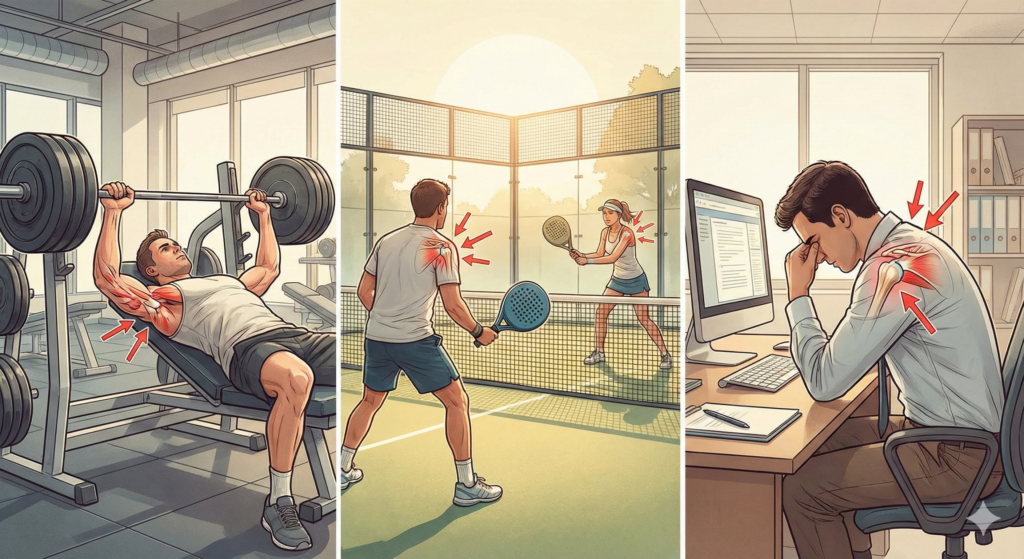
Several regional factors increase the incidence:
1. High gym activity
Bench press, overhead press, dips, CrossFit and weightlifting place significant stress on the supraspinatus and biceps tendon.
2. Overhead sports
Padel, tennis, volleyball, swimming, cricket and MMA are very popular and cause repetitive micro-trauma.
3. Long working hours at computers
Postural fatigue with rounded shoulders predisposes to impingement and tendon overload.
4. Age-related degeneration
More common from age 40–45.
5. Diabetes
Highly prevalent in UAE; accelerates tendon degeneration and slows healing.
Types of Rotator Cuff Tears
Understanding the type of tear helps guide treatment:
1. Partial-thickness tear
Only part of the tendon is damaged.
Common in active individuals aged 30–50.
2. Full-thickness tear
The tendon is completely torn.
More typical from age 50+ or after trauma.
3. Traumatic tear
Occurs after a fall, sudden lifting injury, or shoulder dislocation.
4. Degenerative tear
Progressive wear over time—often asymptomatic initially.
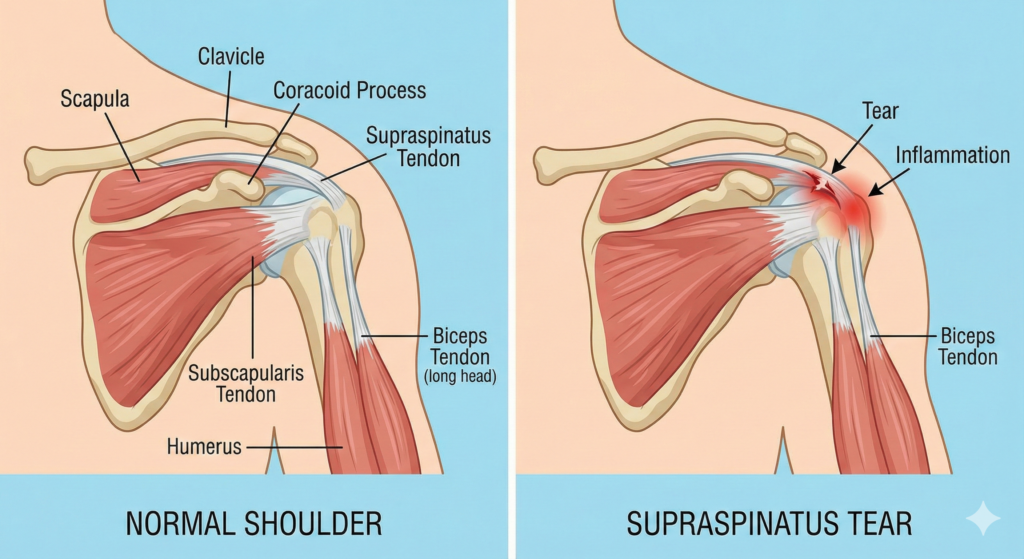
Most Common Symptoms
Patients in Abu Dhabi usually report:
- Pain when lifting the arm
- Night pain (especially when lying on the affected side)
- Weakness and difficulty raising the arm
- Sharp pain during gym exercises
- Stiffness
- Reduced mobility
- Clicking or catching sensations
If pain persists for more than 2–3 weeks, a specialist assessment is recommended.
When Should You Seek Medical Attention?
Consult a shoulder specialist if you experience:
- Sudden loss of strength
- Pain interfering with sleep
- Traumatic injury (fall, heavy lifting)
- Persistent pain not improving with rest
- Difficulty performing overhead movements
Early diagnosis prevents tears from progressing.
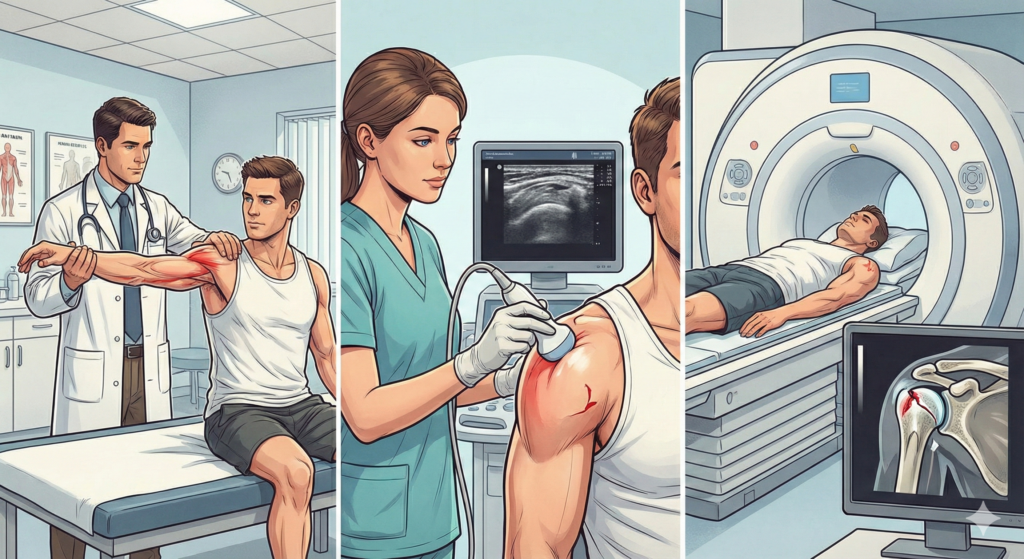
How Are Rotator Cuff Tears Diagnosed?
1. Clinical Shoulder Examination
A detailed assessment of strength, range of motion, and tendon-specific tests.
2. Ultrasound
A fast, dynamic assessment of the tendon.
Useful for screening.
3. MRI (1.5T or ideally 3T)
The gold standard.
Shows:
- Size of the tear
- Retraction
- Muscle quality
- Associated injuries (biceps, labrum, bursitis)
MRI is essential for planning treatment.
Treatment Options for Rotator Cuff Tears in Abu Dhabi
1. Conservative Treatment (First line for many cases)
✔ Physiotherapy
Focused on:
- Strengthening the scapular stabilizers
- Improving posture
- Regaining shoulder control
- Reducing impingement
✔ Activity Modification
Reducing overhead lifting and certain gym exercises.
✔ Anti-inflammatory medication
Short-term use.
✔ Subacromial or ultrasound-guided injections
Useful for pain control, especially in impingement or bursitis.
Conservative treatment is effective for many partial tears.
2. When Is Surgery Recommended?
Surgery is considered when:
- The tear is full-thickness
- There is acute trauma with weakness
- Pain persists beyond 3–4 months despite physiotherapy
- The tendon is retracting (MRI)
- The patient is young or very active
- There is night pain and functional limitation
Early repair is especially important in traumatic tears to prevent irreversible muscle degeneration.
3. Arthroscopic Rotator Cuff Repair
In Abu Dhabi, rotator cuff repair is typically performed arthroscopically (keyhole surgery), offering:
- Minimal incisions
- Faster recovery
- Less pain
- Early rehabilitation
- Better visualization of all shoulder structures
The tendon is reattached to the bone using sutures and anchors.
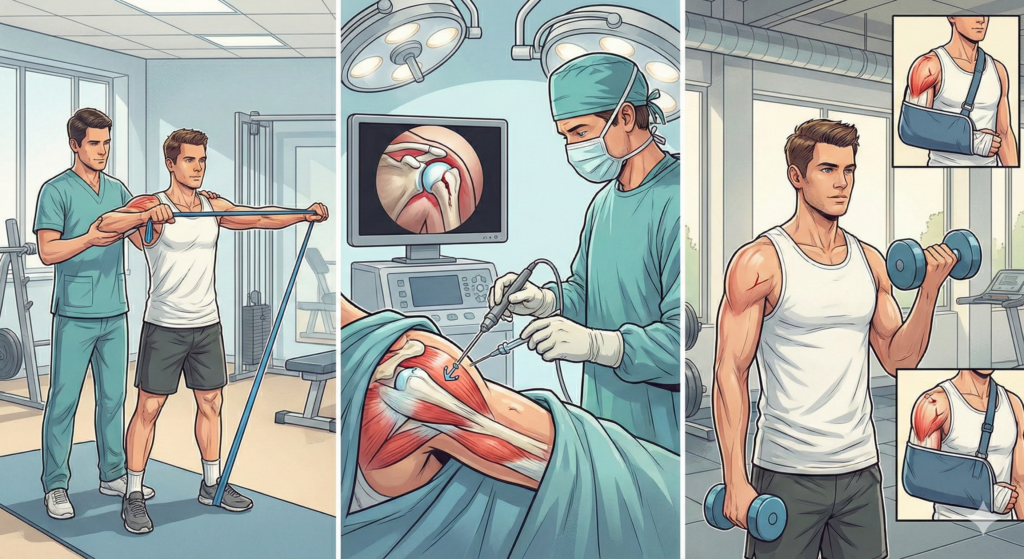
4. Recovery Timeline
Typical recovery phases:
- 0–6 weeks: Sling protection, passive movement
- 6–12 weeks: Active movement, early strengthening
- 3–6 months: Functional recovery
- 6–12 months: Full return to sports
Diabetic patients may require more time due to slower tendon healing.
Preventing Rotator Cuff Problems
Especially relevant in Abu Dhabi:
- Improve posture during desk work
- Balance chest and back muscle training
- Avoid excessive overhead lifting
- Strengthen the rotator cuff and scapular muscles
- Warm up before padel/tennis
- Maintain optimal metabolic control (diabetes, thyroid)
Frequently Asked Questions (FAQs)
Do all rotator cuff tears require surgery?
No. Many partial tears improve with physiotherapy and strengthening.
Is MRI always necessary?
Yes, to plan treatment and evaluate tendon quality.
Can I return to gym training after a rotator cuff tear?
Yes—gradually and under professional guidance.
How long is recovery after surgery?
Most patients return to normal activities in 3–6 months.
Conclusion
Rotator cuff tears are very common in Abu Dhabi due to lifestyle, sports habits, and high rates of diabetes.
The good news is that—with accurate diagnosis and a tailored treatment plan—most patients recover fully and return to an active lifestyle.
If shoulder pain persists, early specialist evaluation is essential to prevent worsening of the tendon.